01 The Profile
Hormusji Cama
Custodian of a newspaper that has appeared without interruption since 1822 — and, for nearly two decades, one of the steadying hands behind the institutions that hold Indian print journalism together.
- Position
- Managing Director,
Mumbai Samachar - Recognition
- Padma Bhushan,
2024 - Field
- Literature & Education —
Journalism
02 Introduction
A publisher, first
and last
Hormusji Nusserwanji Cama is Managing Director of Mumbai Samachar, the Gujarati-language daily founded in Bombay on 1 July 1822 and the oldest continuously published newspaper in Asia. He is also a director of Bombay Associated Newspapers. His family has been the paper's proprietor since 1933, which places him in the third stretch of a custodianship now more than ninety years old.
That is the plainest description of him, and he has rarely sought a more elaborate one. What gives the description its weight is the second half of his working life: the years spent inside the trade bodies that decide how Indian newspapers are counted, measured, defended and represented. He has been President of the Indian Newspaper Society for two terms, Chairman of the Press Trust of India, Chairman of the Media Research Users Council, and Chairman of the Audit Bureau of Circulations. He remains an active member of the boards of all three of the first-named bodies.
In January 2024 the Government of India announced the Padma Bhushan for him in the field of Literature and Education — Journalism. The Ministry of Information and Broadcasting described him simply as a senior publisher from Maharashtra, cited for promoting Indian languages and encouraging reading habits among people. It is an unusually accurate citation. The two things it names — language and the habit of reading — are the two things a 200-year-old vernacular daily exists to protect.
Read the full profile for the detail behind each of these positions, or begin instead with the chronology.
03 Context
What it means to hold a newspaper
that is older than almost everything
around it
Mumbai Samachar was started by Fardunjee Marzban, a Parsi scholar and priest who had already established the first native press in Bombay in 1812 and a Gujarati calendar in 1814. The first issue carried advertisements, government notices, shipping intelligence, news from Calcutta and Madras, and dispatches from as far as Canton. It was a weekly until 1832, twice-weekly until 1855, and has been a daily ever since.
The paper passed through several hands before the Cama family became its publishers in 1933. It has been printed from the same red building at Horniman Circle in Fort, Mumbai, for generations of readers — an address that has become part of the city's own description of itself.
On 14 June 2022 the Prime Minister took part in the bicentenary celebration and released a commemorative postage stamp marking two hundred years of publication. Very few commercial enterprises anywhere reach that mark. Almost none do it while still publishing daily in the language they began in.
04 Selected Highlights
Six dates that carry the record
1822
The paper
Mumbai Samachar appears for the first time on 1 July. It has not stopped since, making it the oldest continuously published newspaper in Asia.
2006
The society
Elected President of the Indian Newspaper Society for 2006–07 at its 67th Annual General Meeting in Bangalore — the first of two terms in that chair.
2015
The agency
Elected unanimously as Chairman of the Press Trust of India on 14 September, taking responsibility for the country's principal news cooperative.
2018
The audit
Elected Chairman of the Audit Bureau of Circulations for 2018–19 — the body in which publishers, agencies and advertisers agree on how circulation is verified.
2022
The bicentenary
Two hundred years of continuous publication are marked on 14 June with a commemorative postage stamp released at the celebration.
2024
The honour
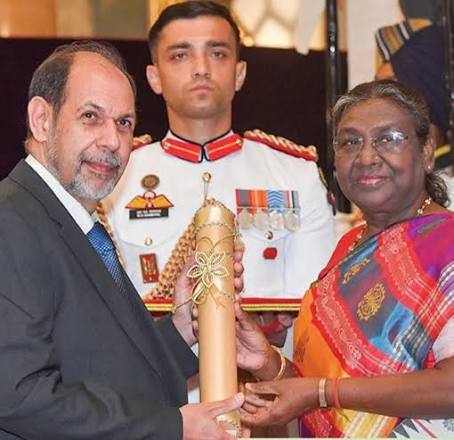
The Padma Bhushan, announced on the eve of Republic Day and conferred by the President of India on 9 May at Rashtrapati Bhavan.
05 The Journey
Read in chapters
The Journey page sets out the verified record in sequence — the inheritance, the elected offices, the bicentenary, the honour.
06 Legacy
The measure of a publisher is
whether the paper is still there
the morning after.
Continuity is the least dramatic achievement in publishing and the hardest. The Legacy page examines what has actually been kept going — a language, a masthead, a set of shared industry standards — and is careful to claim nothing beyond what the record supports.
07 Insights
Themes drawn
from the record
Editorial essays on the questions a two-century newspaper raises — written by this publication, and never presented as his words.
08 In closing
An archive is only useful
if someone answers.
For enquiries relating to this profile — permissions, corrections, additional material or interview requests — the contact page carries a direct line.