Hormusji Cama An Editorial Archive

Work Roles, bodies and responsibilities

The work,
and what it consists of

Six institutions. One masthead. This page describes each role and what the institution behind it actually does — no case studies, no clients, no figures.


The principal role

Managing Director,
Mumbai Samachar

The paper is published by The Bombay Samachar Pvt. Ltd from Horniman Circle, Fort, Mumbai. It appears in Gujarati and English. He is its Managing Director; earlier industry notices list him as Director. He is also a director of Bombay Associated Newspapers.

Running a daily newspaper is not one job but the coordination of several that all have the same deadline: an editorial operation, a printing operation, a distribution network, an advertising business and a subscriber base — every one of which has to deliver every single day, in a city that does not wait.

What distinguishes this particular managing directorship is the length of the run behind it. A paper founded on 1 July 1822, weekly to 1832, twice-weekly to 1855 and daily since, has no natural pause built into it. The obligation is inherited along with the title.

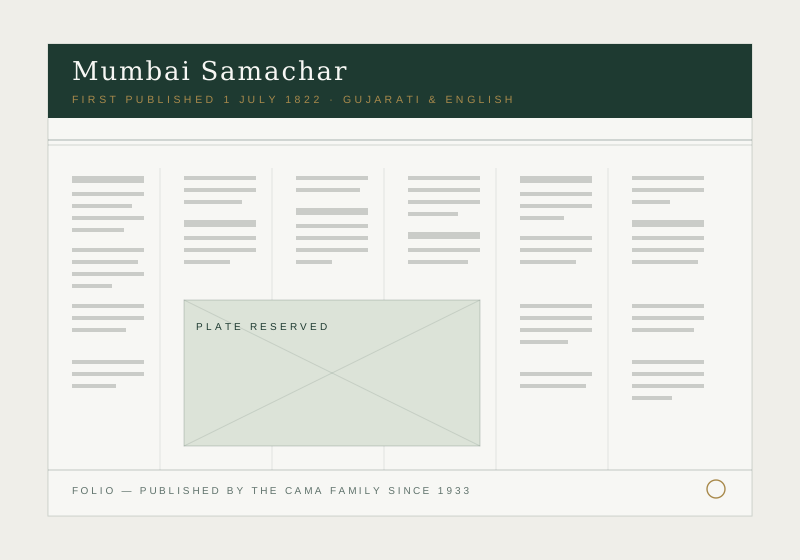
Diagram of a newspaper broadsheet: a masthead band reading Mumbai Samachar above a folio note recording first publication on 1 July 1822 in Gujarati and English, six ruled text columns, and a reserved illustration panel.
Plate V A schematic broadsheet, drawn for this page. It records only what is documented: the founding date, the languages, and the year the Cama family became proprietors.

Offices held

Four industry bodies, chaired

Indian Newspaper Society

President

Two terms · first for 2006–07

The representative body of newspaper publishers in India. He was elected at the Society's 67th Annual General Meeting in Bangalore in September 2006, representing Bombay Samachar Weekly, and succeeded Jacob Mathew of Malayala Manorama. The presidency is a one-year office; he has held it twice. He remains an active member of the board.

Press Trust of India

Chairman

Elected unanimously, 14 September 2015

India's principal news agency, structured as a cooperative owned by the newspapers it serves. Chairing it means presiding over a board whose members are competitors in every other room they share. Riyad Mathew was elected Vice Chairman at the same board election. He remains an active member of the board.

Media Research Users Council

Chairman

Term dates not established in the public record

MRUC is the body through which publishers, advertisers and agencies jointly commission readership research. Its output is the shared evidence base on which media buying decisions across the industry are argued. He remains an active member of the board.

Audit Bureau of Circulations

Chairman

2018–19 · elected unanimously, September 2018

ABC verifies the circulation figures that publishers claim. Its Council of Management is drawn from three constituencies with competing incentives — publishers, advertising agencies and advertisers — which is precisely what makes its certification worth something.

The approach

What this kind of
work involves

Descriptions of the institutional functions themselves. Where a responsibility is inherent to an office he has held, it is described; where it is not documented, it is not asserted.

Presiding over rivals

Every one of the four bodies is composed of competing publishers. The chair's task is to produce decisions that all of them will abide by afterwards — which is a different skill from running a company, and a rarer one.

Defending the measurement

Circulation audit and readership research determine how advertising money is allocated across an entire industry. Their credibility is the industry's credibility. Chairing ABC and MRUC places a publisher on the side of independent verification, including where verification is inconvenient.

Sustaining shared infrastructure

A cooperative news agency lowers the cost of serious journalism for every member, and disproportionately for smaller and regional titles. Keeping PTI functioning is work whose beneficiaries are mostly other people's newspapers.

Publishing in a language, deliberately

Continuing to publish a Gujarati daily in Mumbai is a commercial choice with a cultural consequence. The Padma Bhushan citation named the promotion of Indian languages and the encouragement of reading habits — the two outcomes of that choice.

Custodianship of a record

An unbroken 200-year sequence is an archive as well as a business. Maintaining it means the paper's own back file remains one of the longer continuous records of commercial and civic life in western India.

Scope

Deliberately
incomplete

There are no case studies on this page, and there will not be. No client names, no revenue figures, no circulation numbers, no counts of anything. None of that is established in the sources available for this profile, and a work page that invented it would be a brochure rather than a record.

What is here is the verifiable structure of a career: one publishing house, one associated company, and four industry bodies whose functions are matters of public fact. The Journey page places these in sequence; the Legacy page considers what they add up to.

Continue

The questions
behind the offices.

The Insights journal takes the themes this work raises — language, measurement, and time — and examines them as ideas rather than as biography.

Open the journal Make an enquiry