Hormusji Cama An Editorial Archive

Insights An editorial journal

Three essays on
publishing for the long term

Authorship. These essays are written by this publication. They are reflections prompted by the documented record; nothing in them is a statement by Hormusji N. Cama, and no sentence here is presented as a quotation from him.

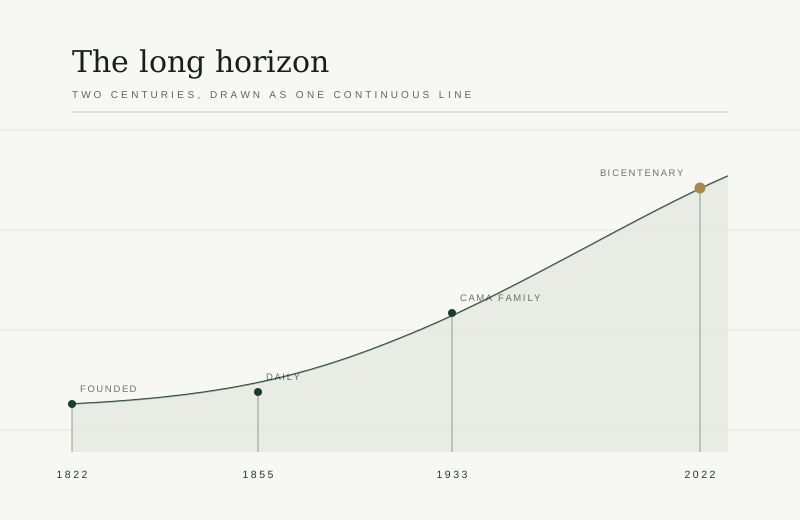
Editorial diagram titled The long horizon: two centuries drawn as one continuous rising line, marked at 1822 for the founding, 1855 for the move to daily publication, 1933 for the Cama family proprietorship, and 2022 for the bicentenary.
Plate VI The long horizon. Drawn for this journal from four verified dates.

Editor's note

A career spent inside an institution older than the modern Indian state raises questions that outlive the individual. Three of them are worth setting down.

Each essay states its factual basis explicitly and separates that basis from the argument built on it. Where an inference is being made, the text says so.

01

Language

Why a language needs a daily

The Padma Bhushan citation for Hormusji N. Cama, published by the Ministry of Information and Broadcasting in 2024, names two things: promoting Indian languages, and encouraging reading habits among people. It is a citation for a publisher, and it puts language before everything else. That ordering deserves attention.

A language survives in three places: in speech, in literature, and in the ordinary daily traffic of commerce and public notice. The first two are usually secure. The third is not, and it is the one a newspaper occupies. When a Gujarati daily prints shipping timetables, tender notices, obituaries and business news, it keeps the language attached to money, law and death — the three domains in which people cannot afford to be imprecise.

A language that has left the marketplace has begun, quietly, to become a heritage item.

Mumbai Samachar has been doing exactly this since 1822. Its first issue carried advertisements, government notices, shipping intelligence and market news from as far as Canton. Two centuries later the categories have barely changed. That continuity is the mechanism by which a language stays operational rather than merely cherished.

There is a commercial argument against it, and it is not a stupid one. English titles in Mumbai reach the advertisers with the largest budgets. A vernacular daily in the same city works with thinner margins for structural reasons. Choosing to continue anyway is a decision that has to be renewed every year, and it is renewed by the person who signs the accounts. The citation, read carefully, honours that renewal rather than any single achievement.

02

Measurement

The arithmetic of trust

Two of the four bodies Hormusji N. Cama has chaired exist for a single purpose: to make claims checkable. The Audit Bureau of Circulations, which he chaired for 2018–19, verifies circulation. The Media Research Users Council, which he has also chaired, commissions readership research on behalf of publishers, advertisers and agencies together.

Neither body produces journalism. Both are indispensable to it. An advertising market runs on numbers that all parties accept; without a shared and independently audited count, every negotiation restarts from zero and the advantage passes to whoever asserts most confidently. Verification is what stops a media market from becoming a contest in self-description.

The point of an audit is that it can go against you.

What is structurally interesting about the Audit Bureau is its Council of Management: publishers, advertising agencies and advertisers, sitting together. These three groups have opposed interests in almost every specific case — a publisher wants the number high, an advertiser wants it conservative, an agency wants it defensible. The bureau works precisely because none of them controls it.

A publisher who accepts the chair of such a body is accepting the discipline as well as the office. It is worth noting that the same person also chaired the readership council, which measures a different quantity by a different method. Taken together, that is a career-long position on the side of the count rather than the claim.

03

Time

Custodianship as a long game

Most institutions are younger than the people running them expect to remain relevant. Mumbai Samachar is not. Founded on 1 July 1822, it predates the Indian republic by 125 years, the Cama family's proprietorship by 111 years, and every person currently working on it by a margin that cannot be closed.

That changes the arithmetic of every decision. In a young company, a five-year horizon is long-term thinking. In a two-hundred-year-old daily, five years is barely a rounding error, and the relevant question about any choice is not whether it maximises the current period but whether it leaves the sequence intact.

The custodian's question is never what can we gain. It is what must not be lost.

This is a genuinely unfashionable posture. Contemporary media strategy is built on pivots, relaunches and repositioning — all of which are, in effect, bets that discontinuity will pay. A custodian is holding the opposite position: that the accumulated value of an unbroken run exceeds anything a redesign can generate, and that the value is destroyed permanently by a single interruption.

The 2022 bicentenary — marked with a commemorative postage stamp released at the celebration on 14 June — is the proof of that bet paying. Very few commercial enterprises of any kind reach two hundred years. The ones that do are almost never the ones that were most aggressive at any particular moment. They are the ones that were still there the next morning.

It is a difficult lesson to generalise, because it cannot be adopted late. An institution either has a continuous record or it does not, and the only way to acquire one is to have not stopped.

Sources for these essays

The factual basis for all three essays is the same as for the rest of this archive: the founding and publication history of Mumbai Samachar; the announced and conferred Padma Bhushan of 2024 with its published citation; and reported elections to office at the Indian Newspaper Society, the Press Trust of India, the Media Research Users Council and the Audit Bureau of Circulations. The arguments drawn from those facts belong to this publication alone.

Continue

Corrections are
welcome here.

If any statement on this site is inaccurate, or if material exists that would let a section be told more completely, the contact page carries a direct line.

Get in touch Back to the profile