Hormusji Cama An Editorial Archive

Journey Chapters of a record

Two hundred years,
read in order

A chronology assembled only from dates that can be verified. Where a year is not established in the public record, no year is given.


1822

Founded in Bombay by Fardunjee Marzban. Weekly.

1855

Becomes a daily, and has remained one ever since.

1933

The Cama family becomes the paper's proprietor.

2022

Two hundred years of uninterrupted publication.

1812–1855

Chapter one · Beginnings

A press, a calendar, and then a newspaper

The story does not begin with the Cama family, and it is more interesting for that. Fardunjee Marzban, a Parsi scholar and priest, established the first native press in Bombay in 1812 and a Gujarati calendar in 1814. On 1 July 1822 he brought out the first issue of Bombay Samachar: three quarto sheets of ten inches by eight, plus a supplement, fourteen pages in all.

Its contents were exactly what a trading city needed. Advertisements. Government notices. Shipping intelligence. News from Calcutta and Madras. And dispatches from further afield — including, in that first issue, prices from Canton, opium among them. It was a commercial paper for a commercial port, printed in the language its readers did business in.

It appeared weekly until 1832 and twice weekly until 1855, when it became a daily. It has been a daily ever since. That single unbroken sequence, more than any other fact, is what everything on this site ultimately concerns.
1933

Chapter two · The inheritance

A newspaper comes to the Cama family

The paper passed through several hands across its first century before coming to the Cama family, its present publishers, in 1933. It was already 111 years old. Nobody acquiring it in 1933 could have described the purchase as an opportunity in the ordinary sense; what they acquired was a duty with a circulation attached.

The premises are part of the inheritance too. Mumbai Samachar is published from Horniman Circle in Fort, Mumbai, from a red building that has become one of the recognised faces of the old city — an address that appears in descriptions of Bombay almost as often as the paper appears on newsstands.

Hormusji N. Cama is the custodian of that inheritance in its ninth decade under his family. The About page sets out what the public record establishes about him, and — equally deliberately — what it does not.

2006–07

Chapter three · Into the trade

President of the Indian Newspaper Society

In September 2006, at the Society's 67th Annual General Meeting in Bangalore, he was elected President of the Indian Newspaper Society for 2006–07. He represented Bombay Samachar Weekly, Mumbai, and succeeded Jacob Mathew of Malayala Manorama, Kottayam. Bahubali S. Shah of Gujarat Samachar took office as Deputy President in the same year.

The Society is the representative body of newspaper publishers in India. Its presidency is a one-year office and rotates widely across languages and regions, which makes the fact that he held it for two terms worth noting on its own. The second term is documented in the record; its years are not, and this site therefore does not state them.

This is the moment at which his working life stops being about one masthead. From here on, the record is largely a record of what he did on behalf of everybody else's.

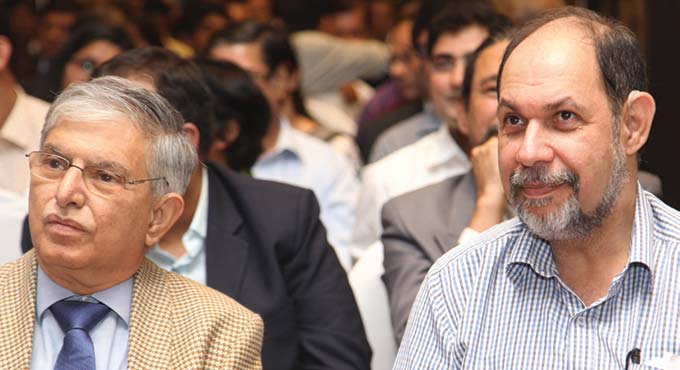
Hormusji N. Cama, at right in a checked shirt, seated in the audience at an industry gathering beside a senior colleague in a jacket and tie, with further delegates behind them.
Plate III In the audience at an industry gathering. Much of the work described on this page happens in rooms that look exactly like this one.

2015–2019

Chapter four · The chairs

The agency, the research council, the audit

On 14 September 2015 he was elected unanimously as Chairman of the Press Trust of India. PTI is a cooperative owned by its member newspapers; its chairman presides over the board of the organisation that supplies much of the country's shared news report. Riyad Mathew was elected Vice Chairman at the same board election.

He has also served as Chairman of the Media Research Users Council, the body through which publishers, advertisers and agencies commission readership research together. And in September 2018 he was elected unanimously as Chairman of the Audit Bureau of Circulations for 2018–19 — the bureau whose Council of Management is drawn from all three of those constituencies, and whose entire purpose is to make circulation figures checkable rather than asserted.

He continues to serve as an active member of the boards of the Indian Newspaper Society, the Press Trust of India and the Media Research Users Council. The Work page explains what each of these institutions does.

2022

Chapter five · The bicentenary

Two hundred years, and a postage stamp

On 14 June 2022 the bicentenary of Mumbai Samachar was marked in Mumbai. The Prime Minister took part in the celebration and released a commemorative postage stamp for two hundred years of publication.

Speaking of the paper as it entered its two-hundredth year, Hormusji N. Cama described what it had set out to do at the beginning: serve the thriving business community of Bombay with business news, death announcements and shipping timetables. It is a characteristically unadorned account of a very old institution — and an accurate one. The first issue of 1822 contained precisely those things.

A bicentenary is the one occasion on which a newspaper is entitled to be the story. The record suggests the occasion was used to describe the readers rather than the proprietors.

2024

Chapter six · The honour

Padma Bhushan

On the eve of Republic Day 2024 the Government of India announced the Padma Bhushan for Hormusji N. Cama in the field of Literature and Education — Journalism. The Ministry of Information and Broadcasting's citation named him a senior publisher from Maharashtra, recognised for promoting Indian languages and encouraging reading habits among people.

President Droupadi Murmu conferred the award at the Civil Investiture Ceremony at Rashtrapati Bhavan on 9 May 2024. Two other media figures, Kundan Vyas and Surendra Kishore, received Padma awards in the same year.

The photograph of that moment opens the home page of this archive. It is reproduced there complete and uncropped, which is the only respectful way to publish a photograph of a ceremony.

What comes next

The chronology ends here because the record does. He continues as Managing Director of Mumbai Samachar and as a board member of the Indian Newspaper Society, the Press Trust of India and the Media Research Users Council. Anything further would be speculation, and this archive does not speculate.

Continue

What a chronology
cannot show.

Dates record what happened. The Legacy page asks the harder question: what has actually been preserved, and for whom — a language, a masthead, a set of standards that everybody in the trade relies on.

Read the legacy See the work